

Could adding seaweed to livestock feed reduce emissions from cows?
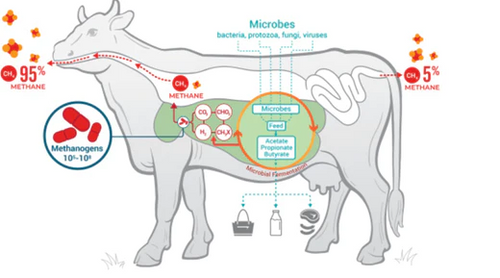
We are constantly amazed by the never-ending exciting innovation going on in the seaweed industry, particularly when it comes to sustainability. With evidence suggesting that adding seaweed to livestock feed can reduce methane from cows by around 82%, we wanted to share our side of the story. And with people like Bill Gates investing, we are all the more excited.
Our Head of Business Development, Arnie Sathiy, has offered some insight into the field. Read his blog below to find out about how seaweed can help fight climate change.

I’ve been with Mara Seaweed for a tick over two years now. I love the learning and the journey has been incredible. A constant battle many of us face is how to do the day job whilst looking after the longer-term growth of a business? I must divide my time between developing sales for our current portfolio (an incredible range of seasonings and whole leaf ingredients, to food service, manufacturing and retailers) vs driving the business forward to match scale plans that allow us to make major step changes in our food systems, look after our soil and animals, as well as make a dent in helping the planet.
Why? Because we can help on so many levels. And it is not just we 11 folks at Mara who believe this. Here we are, being called out globally, on the menus of COP26 by Vincent Doumiezel who leads the United Nations Global Compact.
We did not pay for that opportunity. Our significance is so recognised that they chose to highlight us, a humble Edinburgh and Fife based firm. Mara Seaweed was founded by a woman with a vision in Fiona Houston, often through clenched fists, an iron will and sheer gut determination. And we have got to the stage now where we have the inhouse NPD, Marketing, Supply Chain, Food Safety and Technical talent, and the processes behind those people to flourish. But unlike many pre-output business models, we are not well capitalised – and the market is now flooding with seaweed businesses that are sweeping up investment capital yet has no finished product and little proof of concept in terms of offtake agreements or concrete sales. And let us be clear, hats off to Rumin8 in Australia – none of this is aimed at them.
Many will of course fail as so many start-ups do; they cannot process their potential seaweed biomass, have not perfected drying techniques and some may have a rather laissez-faire attitude to food security, safety and allergens – attitudes which will kill them off quick-sharp when the time comes. There are only a few solid A* seaweed producers on this small isle we call home, capable of a healthy, informed supply chain, year-round like Mara Seaweed.
Mara is in fairness both chicken and egg, and without substantial scale, we remain caught between how to twist and must stick.
Bill Gates and his Breakthrough Energventures have caught the imagination of media interest with ‘his’ $12m investment into Australian firm, Rumin8 – published widely this week.
Let’s be clear seaweed occurs at scale, naturally, all over the blue bits of our graceful, bio-rich planet. Species vary based on things like flow rates and water temperature and seaweed remains a sensitive creature. Some (think grey squirrel if you will) are invasive and cause trouble for other indigenous species which could be catastrophic for all biodiversity in that maritime zone. That’s why we work with the Oceans Institute and Crown Estate to ensure our licensed activity is always top drawer.
Bill Gates is no mug. For Bill to invest $12m is the kind of noise and investment Mara and the global industry needs.
All this said, we must tread carefully. The Beef & Dairy Industry, according to the FAO contributes to 14.5% of the world’s carbon emissions, that’s a lot of pain.
Let this sink in for a moment with some context.
Every single transport vehicle on Earth (rail, aviation, 2-3 wheels, passenger transport, heavy haulage and shipping) equates to 20%. Just ¼ more than cows burping and to a far lesser extent, farting. I cite transport because it is easier to envisage an exhaust pipe than it is a cow, letting off a good burp… and let’s face it, this incredible stat will be widely unknown.

Big science for the feedstock, dairy and beef industries already knows that seaweed acts as a net inhibitor on enteric emissions (enteric means relating to intestines, I.e. cattle producing carbon emissions).
Rumin8 are claiming 80%-98% reductions through seaweed, and to be fair, that Asparagopsis research is not new. By my maths, that equates to removing 6 in 10 vehicles (OF ALL TYPES!) from the road, air, rail and sea in terms of emissions. Just imagine that! If every ruminant got to net zero because Planet Earth made it law to feed them some seaweed… 60% of all transport emissions would be removed.
Of course, we need to get cattle safety right, not affecting beef or milk taste is the key, and ensuring long term heard health is protected – these farmers who work 365:24:7 and their livelihoods and heath of the animal must be preserved. But this should be a law.

For that to happen, money must be spent so DEFRA can be satisfied with proven scientific health research. Unfortunately, as is so often the case, natural solutions are so often overlooked with man-made over complicated options…mother earth often DOES know best!
Some pharma companies (firms often labelled the necessary evil) are manufacturing synthetic capsules that one could feed cattle to bring down their emissions. Why, when seaweed is abundant, naturally available and if farmed correctly, produces its own natural solution. We have gone too far in our approach to over-sciencing the solution. It was here all along. Further, non-anecdotal evidence occurs the world over, with infamous herds eating seaweed, like our blessed Ronaldsaay sheep above. Man and animal have been eating seaweeds for 000s of years. Long before ResearchGate produced a 360 image like this:

Calculating how much of what seaweed species, in what volume and when should it enter the feed chain is not easy. No one is arguing seaweed is a fulltime substitute for grass feed. It is the heavily “bought in” supplemental feed that we should be looking to mitigate against, and now.
If we achieved 50% carbon reduction in enteric emissions with UK indigenous seaweed species, compared to Rumin8’s 80%-98% reduction, that multiplied around the world is 50% of all emissions through travel removed… from a cow eating something it loves?!
So here I stand, a little stressed by the complexity of bringing a lobby together to help the Dairy Industry, the Feedstock markets and UK Gov make the right decision. So Bill, if you want to chat, give me a call – because UK Academia, and Seaweed Research is here for you and we all need this message sung from every rooftop and cattle shed, from here to Seattle, and all the way to the legends down in Western Australia Rumin8."
If you want more information on this journey, how you might consume the most mineralised vegetable on the planet which lessens your sodium salt intake too, head to www.maraseaweed.com
Thanks for reading, and please, do your little bit and share this, or comment. Get those social algorithms popping!

